The Japan Society North West will be holding its Japan Day 2010 on Sunday October 17th in the Alexander Suite of the Midland Hotel, Manchester from 11am to 5pm. There will be 45 stalls offering information and products on every aspect of Japan from food and drink to Japanese textiles, gardens, bonsai, manga, koi fish, ukiyo-e prints, dolls etc etc. In addition there will be a stage with performances running throughout the day of taiko drumming, kendo, aikido, kimono fashion etc.
I will be manning the Japanese literature stall in the centre of the room as well as chewing the fat over favourite authors and current projects. Entry to the whole event is completely free of charge.
The last Japan Day in Manchester two years ago drew a huge crowd so it should be a bustling event this time as well. More information is here:
http://www.jsnw.org.uk/
Monday, 11 October 2010

Sunday, 25 April 2010
Discussing Endo on Open Book
You can hear me discussing that marvellous Japanese author Shusaku Endo with the author Caryl Philipps and Mariella Frostrup on the BBC Radio 4 programme Open Book.
http://www.bbc.co.uk/programmes/b00s1pdx#synopsis
Some of Endo's books have recently been released on audiobooks, but listening to Caryl Philipps' wonderfully rich, soothing and mellifluous tones made me think that Caryl should perhaps voice some audiobooks himself.
Incidentally I love Caryl's description of Endo's masterpiece Silence as 'K2', encouraging new readers to take it easy amongst the foothills before attempting this daunting summit.
We await with interest to see when Martin Scorcese's film of Silence - in planning now for many a year with quite a few Hollywood A-listers linked to it - will be completed. It will surely mark the start of a long overdue 'Endo-boom' when it is finally released.
http://www.bbc.co.uk/programmes/b00s1pdx#synopsis
Some of Endo's books have recently been released on audiobooks, but listening to Caryl Philipps' wonderfully rich, soothing and mellifluous tones made me think that Caryl should perhaps voice some audiobooks himself.
Incidentally I love Caryl's description of Endo's masterpiece Silence as 'K2', encouraging new readers to take it easy amongst the foothills before attempting this daunting summit.
We await with interest to see when Martin Scorcese's film of Silence - in planning now for many a year with quite a few Hollywood A-listers linked to it - will be completed. It will surely mark the start of a long overdue 'Endo-boom' when it is finally released.
Friday, 19 March 2010
Off With Their Heads
During January and February I was very busy having children. Or I should say I was attendant on the act of birth. (Every time I turn round these days another child has appeared. Where do they all come from? Someone really must explain it to me, but in the meantime I've had my hands full with my one-year-old son and two-month-old daughter.)
For two months I was too busy to read even a single newspaper, but kept receiving them by the bag-load. Whereupon, feeling exhausted and stressed, I proceeded to put bag after bag of newspapers into a large trunk in a room at home I quaintly call 'The Raj Room'. Finally at the end of February I had acquired a quite vast quantity of newspapers. Obsessive compulsion disorder demanded that I finally sit down and over the course of a few days catch up, in entirely random order, on nine weeks of news, features and seemingly endless supplements.
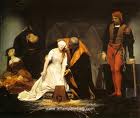
Buried deep in the newspaper mountain was an article on the new exhibition at the National Gallery. It's called 'Painting History: Delaroche and Lady Jane Grey' and runs until 23 May. The exhibition apparently offers a reappraisal of the painter Paul Delaroche (1797-1856), who had sunk into critical oblivion during the twentieth century, but whose painting The Execution of Lady Jane Grey has proved to be one of the most popular amongst all those at the National Gallery.
But, hang on a minute. The title story in the book I published in 2005, The Tower of London, has at its heart precisely this subject. 'The Tower of London'
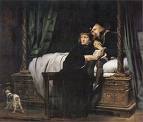 is an eerie fantasy meditating on the nature of time and history, where a Japanese visitor to the Tower of London spies the ghost of Lady Jane Grey and the blood-splattered climax of the story is a re-enactment of Delaroche's picture. Not only that, but Soseki actually includes a re-enactment of another Delaroche painting The Princes in the Tower (pictured right) in the same story.
 What a pity, I thought, that the organizers of this exhibition had no idea that Delaroche's paintings, and The Execution of Lady Jane Grey in particular, had gone on to inspire a classic work of Japanese literature. What a fascinating coda to the exhibition it would have made if there had been some reference to this. The exhibition apparently notes that Delaroche was influenced by theatre, yet in Soseki's literary rendition, it is almost as if the pictures have been returned to their theatrical setting as he refers to the 'stage of the imagination' and treats the re-enactment of the pictures as scenes of a play. Soseki was fascinated by the interaction of visual and literary arts and in his early work was striving to summon up 'word-paintings', with famous pictures like Delaroche's fused into the fabric of his literary works.
This seemed like too good an opportunity to miss and so I dashed off some emails to the National Gallery. If nothing else, I suggested, would it not be a good idea to pile up some copies of Soseki's Tower of London at the exhibition so visitors could find out for themselves what the intriguing worldwide influence of Delaroche's paintings have been?
Gratifyingly I did receive a nice email from the guest curator, expressing interest in Soseki's story but regretting that she was just about to depart to Italy for three weeks (ah, the life of the fine art critic). Yet following it came the inevitable email from the National Gallery shop explaining that if only they had known about the book they would of course have stocked it, but unfortunately now all the exhibition book budget had been spent and all the shelf space allocated...
While we are on the subject, can someone tell me why they don't sell Soseki's The Tower of London at the shop at the Tower of London (pictured right)? I mean Soseki is the
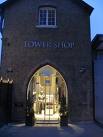 most important Japanese writer of the modern age and his story 'The Tower of London' was one of his breakthrough works. There seems however only to be space for books on the history of the Tower of London or Tudor history or pop-up books for children. Trying to persuade the Tower of London shop that they might also have room for a world literary classic and you descend into a Kafkaesque world of bureaucratic jobsworthiness. My dear sir, to have a book sold at the Tower of London shop you must first submit an application to Her Majesty's Palaces, whereupon the book will be scrutinized for its worthiness, suitability and public appeal...and so on and so on.
 Is it really that people don't want to know anything more than endless rehashes of Tudor History? Or are they are simply prevented from finding ways of expanding their knowledge of the world, of seeing the myriad ways in which cultures, and the visual and literary arts, interact? I can't help finding it sad that the only people who get to read the classics of Japanese literature are those on Japanese courses or those with a particular interest in Japan. And yet so many of the stories themselves, like 'The Tower of London', are patently universal in appeal and connect to a multitude of fascinating subjects which have nothing to do with Japan. The only problem is these literary classics are consistently excluded from all the places where you should be able to easily acquire them.
Sunday, 7 March 2010
Translating Chinese Couplets
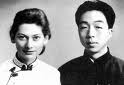
The death in November last year of Yang Xianyi, the 93-year-old veteran translator marked the end of an era in terms of the transmission of Chinese culture to the West. Lengthy obituaries hailed the achievements of this most prolific of translators, who together with his English wife Gladys (pictured above) produced over 60 books of translations of the Chinese classics, ranging from the 4-volume Selected Works of twentieth century novelist Lu Xun to the lyrical poem from the fourth century BC Li Sao and from the works of post-Mao writers to the vast eighteenth century novel The Dream of Red Mansions.
The lives of Yang Xianyi and Gladys Yang read like a film script and it is hard to think that any of the new generation of translators will live through such turbulent and extraordinary times. The grandson of a senior provincial governor and the son of a Bank of China official in the city of Tianjin, who amassed a fortune partly through dealings with warlords, Xianyi was at first educated in the Chinese classics and then sent to a British missionary school where most of the classes were in English. There he immersed himself in English literature, translating Milton into classical Chinese verse, before conceiving of the desire to learn Latin and Greek, which brought him in 1936 to Merton College, Oxford.
After two years he switched to studying French literature and finally English literature, taking tutorials with the poet Edmund Blunden. He was hardly a star pupil however, spending liberally and travelling extensively, and generally acquiring the reputation of a playboy. He did find time however to set up an anti-Japanese Chinese newspaper and, thanks to the Oxford China Society, fell in love with Gladys Tayler, the first undergraduate to study Chinese at Oxford. He finally emerged with a fourth-class degree, which he referred to as 'a rare beast'.
Gladys was the daughter of missionaries in China and had spent her early childhood in Beijing before being packed off to boarding school in England. Both of their families were horrified at the thought of their inter-racial union, but nevertheless they returned to China in 1940 and married in the wartime capital of Chongqing, then under the control of Chiang Kai-shek's nationalists. After the defeat of the Japanese they moved to Nanjing, working as English teachers and translators.
With the fall of the Nationalist regime in 1949, the couple were offered a means to escape to Taiwan, but elected to stay on in communist China and moved to Beijing where by 1952 they were working for the Foreign Languages Press, entrusted with the daunting task of translating the major works of Chinese literature into English as well as producing translations of many propaganda pieces. In his spare time Yang Xianyi also worked on translations, somewhat frowned upon by his communist overseers, of Western literary classics such as Homer's Odyssey, the works of Aristophanes, The Song of Roland and Bernard Shaw's Pygmalion into Chinese.
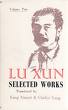
By the 1960's, the Yangs had already produced amongst many other translations, The Selected Works of Lu Xun, the Qing dynasty novel The Scholars and had commenced work on The Dream of Red Mansions. They had two daughters and a son and became mentors to a stream of westerners who came to Beijing to study or teach. But disaster struck when in 1968 they both fell victim to the turmoil of the Cultural Revolution (1966-76) and found themselves thrown into prison for four years. Gladys was kept in solitary confinement while Xianyi shared a grim cell with a mixture of criminals and political prisoners. Neither knew anything about the other's fate and Gladys' mother in England died not knowing what had happened to her daughter.
Finally released in 1972, the couple resumed their translation work, but further tragedy lay ahead. As part of the Cultural Revolution, their children were sent to work in factories or communes in distant provinces and their son Yang Ye began to suffer mental health problems, rejecting the Chinese around him and wishing only to associate with English people. After with difficulty obtaining a visa allowing him to go to the care of family members in London, he committed suicide there in 1979, a tragedy from which Gladys never fully recovered.
In the 1980's the Yangs' home became a salon in Beijing where Chinese and Western writers and intellectuals gathered to freely discuss ideas over copious amounts of gin and whisky. Gladys set about translating the works of a new generation of post-Mao writers and became interested in the Women's Movement, translating the works of Chinese women writers. For a time there was a relaxation of government control and a new openness and in 1985 Yang finally joined the Communist party. But immediately afterwards a reaction set in leading to the massacre of Tiannamen Square in 1989. Xianyi courageously spoke out against the atrocity, comparing China's leaders to fascists, worse even than the warlords of the past or the Japanese invaders.
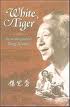
Gladys passed away aged 80 in 1999. The following year Xianyi published his autobiography White Tiger. He was awarded an honorary doctorate by the University of Hong Kong who praised him as a 'master translator'. On September 17 2009, shortly before his death, the Translators Association of China bestowed upon him their Lifetime Achievement in Translation Award with the words 'he is second to none among Chinese translators in terms of quantity, quality and influence'. After his death, John Gittings commented in The Guardian that 'tens of thousands of foreign students of Chinese, from then till today, have relied on their work' and the anonymous obituary writer of The Times agreed that 'they produced a steady stream of translations of very high quality'.
There's seems no doubt then from all the available evidence that the Yangs were extremely good eggs - their hearts were in the right place, they were incredibly diligent and productive, kind, open and unstuffy. In the face of constant political oppression, they were fearless and suffered a great deal in order to be able to devote their lives to the translation of Chinese literature and make accessible that vast continent of knowledge to readers in the West.

For all these reasons, you can't help admiring them. However there is a flip side, which somewhat awkwardly and reluctantly, I feel obliged to point out. The simple fact of the matter is that Chinese literature is still virtually unknown in the West and, apart from students of Chinese, hardly anyone would consider reading these scores of government-backed translations. The Dream of Red Mansions, for example, is one of the great books of world literature, yet how many people in the West have the slightest idea about its contents?
What is the reason for this? When Mao first met Xianyi and heard that he had translated the long poem Li Sao, he expressed scepticism that the poem could be translated, but Xianyi replied that 'I think everything can be translated'. Not everyone however was so convinced. David Hawkes, a friend of Xianyi's, who did his own translation of Li Sao (as well as his own version of Red Mansions) offered the opinion that the translation 'bears as much resemblance to the original as a chocolate Easter egg to an omelette', a remark which apparently amused Xianyi.
My own perspective on the Yangs is unfortunately very different to all the gushing praise of the obituary writers. One of my great literary heroes is Lu Xun, a bust of whom adorns the mantelpiece of my home. He is someone whose work I became familiar with ten years ago when I was PhD student in Japan. Lu Xun is every bit as well known and critically lionized in Japan (where he is known as 'Rojin') as he is in China and has been since his works were first translated into Japanese in the 1920's.
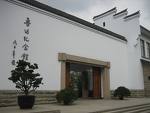
Fascinated both with Lu Xun's life story and his literary works, I made some years ago the pilgrimage to the Lu Xun House and the vast Lu Xun museum (pictured left) in Shanghai. Here I bought the 4-volume Selected Works of Lu Xun in English translation by the Yangs. But upon turning its pages, my heart sank at how leaden and uninspired these translations were. I struggled through volume one before abandoning completely the other three volumes. If this was what I had to go on, I could see nothing at all of interest about Lu Xun's writings, despite his being widely regarded as the greatest writer of modern China.
And yet I am sure that the writings of Lu Xun are some of the greatest of the twentieth century. But I can only say this with confidence because I have been able to read stories such as 'The True Story of Ah Q' and 'Diary of a Madman' in Japanese translation, sometimes comparing it with the Chinese original. Reading them in the Yangs' English translation was an entirely different, dispiriting experience, in which all the richness and savage wit of the original was completely lost.
At the time I had no idea who 'Yang Xianyi and Gladys Yang' were, but merely thought of them as a classic example of the perils of collaborative translations. As in some old-fashioned translations of the Japanese classics where a Japanese person did a first draft that was liberally rewritten by a Westerner who could not even read the original, I could only mistakenly imagine that this was the case here also and that 'Xianyi' had done a first draft into unintelligible English before it was tidied up into readable, if tedious prose by 'Gladys'. I marvelled that a pairing so lacking in talent could have the audacity to produce a full 4-volumes of translations by the great Lu Xun. Little did I know that this was just the tip of the iceberg as regards the enormous translation output of the Yangs.
And some years later when I was in Hong Kong and browsing in an English language bookshop, I thought of seeing if I could lay my hands on a translation of that greatest of Chinese novels, The Dream of Red Mansions, but discovered to my horror that there again were names 'Yang Xianyi and Gladys Yang'. I did not buy the book, but muttered to myself what induced these people to keep on churning out such translations.
Of course now, knowing the full history of the Yangs and everything they went through to produce these translations, I feel acutely embarrassed at my ungratefulness with regards to their heartfelt and herculean labours. But that does not change my strong suspicion that most of their translations were rapidly produced and of questionable quality. Yang Xianyi was I am sure an amiable, amusing and erudite man, and a robust believer in political freedom, but I suspect that there are good reasons both why he emerged from Oxford with a fourth-class degree and why so few people in the West read his translations.
To my mind the great Western discovery of the Chinese classics is a task that still lies ahead and that hopefully next time will be taken out of the hands of state controlled publishers in Beijing and entrusted instead to visionary publishers in the West and first rate academics and writers both with an appreciation for the complexities and subtleties of Chinese and a flair for the English language. Modern couples like Chinese novelist Ma Jian and his English translator wife Flora Drew might be better equipped to bridge the cultural and linguistic divide.
China cannot go on being the cultural elephant in the room, but is now a presence in the world that none of us can ignore. That journey of understanding has to start with the country's literature and its rendering into fresh translations that fully communicate the richness of ideas, colour and passion of the original masterpieces.
Friday, 8 May 2009
Mud, Blood and Poppycock
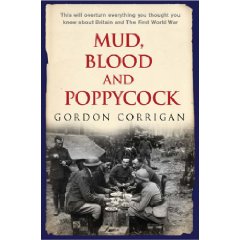
I don't know whether you, dear reader, are a bit like me and log things you mean to get to sometime, though sometime can sometimes take quite some time. Quite a few years back I read a review of a revisionist history of the First World War on the Western Front called Mud, Blood and Poppycock, and logged it as something to read sometime. A few weeks back, as I was in an airport, waiting for a flight to Japan, I happened to come across it, and then spent the next week in Japan reading it.
Now I freely admit that the First World War is one of my obsessions. Anything about it absorbs my interest. For me it is the defining event of the modern world. It ended all the certainties of the civilization that preceded it and left the world in a deep state of trauma for at least 70 years afterwards. Why it happened, how it was conducted and what its consequences were are subjects that I find myself endlessly drawn back towards.
Yet despite having a great interest in the First World War, I must also admit that I don't really seem to have formed many firm opinions on the conduct of the war itself. As for the old chestnut of whether it really was a case of 'Lions led by Donkeys' or whether the generals have been maligned and did the best they could in the circumstances, in purely tactical and strategic terms, I don't really know.
Mud, Blood and Poppycock attempts to convince the reader that all the stereotypical depictions of the war as a campaign of 'endless, needless slaughter' are completely wrong and that nearly all the decisions taken - from Britain's decision to enter the conflict in the first place to the decision to attack on the Somme and Haig's insistence that the war could only be won on the Western Front - were all the right ones.
I learnt a great deal from this book and realised how much I too suffered from many of the common misapprehensions about what went on on the Western Front. Gordon Corrigan goes into great detail about how the British army was composed and what living conditions were actually like. He points out how the system of trenches worked, with front trenches, reserve trenches and support trenches, and how troops were regularly revolved around them and back to barracks behind the lines with few spending more than a few days in the front line every month. He explains how machine guns were set up on the front lines, not directly at the enemy to mow them down (as in popular depictions) but crossways in tandem with other machine guns to create impassable zones in No Man's Land. He points out how most troops were not killed by machine gun fire at all, but by rifle fire and, most of all, artillery.

The book is a robust defence of the British commander Douglas Haig (pictured right) at the expense of his political boss David Lloyd-George, who is portrayed as meddling and dangerously fanciful in his endless quest to divert troops away from the Western front to find the 'soft underbelly' of the Central Powers in places such as Salonika in attempts to end the war quickly.
Although you learn a lot about the military realities of the First World War from this book and despite the fact that it is written by someone with military experience, it doesn't stop the book being completely wrong-headed.
Gordon Corrigan starts from the premise that the war needed to be fought by Britain because the Germans were overtly expansionist and if they had taken control of the channel ports, they would have cut off Britain's trade with the continent, thereby threatening the empire itself. In other words, to defend the interests of the British Empire, the war and all the enormous sacrifice involved was necessary. If you start off with this kind of nationalist perspective, this is the conclusion you might well reach.
But the point is - the British Empire was not worth defending. The British Empire was an evil that inspired yet more evil. It is absurd to accuse the Germans of being 'expansionist' when the whole history of the British Empire was about expansion. When the British seized India, went to war with China over the opium trade, invaded Sudan, grabbed the Boer Republics for their gold and diamonds, as well as a host of other indefensible imperial escapades, usually involving near-genocide and the massacres of tens of thousands, they were teaching the world that the road to being a 'great nation' lay in ruthless military force. For the British to then bleat about a lack of fair play when the Germans learnt this lesson and tried to build their own continental empire at the expense of the Russians and French was staggeringly deluded and only possible because a racist differentiation between white Europeans and non-white 'colonials' loomed large in the British psyche.
It's probably very true that if Britain had not entered the First World War, the Germans would have won and the British Empire would soon after have crumbled - but then good riddance to it. What was a travesty is that so many hundreds of thousands of young men's lives were given up in the defence of such an institution. If Britain herself had not been so rapaciously self-interested and set such an example for others and inspired their resentment, perhaps the war would have never happened in the first place.
As for Douglas Haig and the other generals, well, I'm not military expert and so I can't say whether they were blundering fools still dreaming of cavalry charges in an age of tanks, barbed wire and machine guns or whether they did their job well given that enormous casualties were inevitable once such formidable opponents went to war. (In Norman Stone's recent short book on the First World War, Haig is described as 'Scotland's greatest general - because he killed more Englishmen than any other'). But you can't help thinking that first of all, it really could not have been any worse, could it? I mean, defeat sounds like a better option than victory at this price. And secondly, how is it that Haig and the others kept on going through all the enormous bloodshed. Did something within them not tell them that the war must be stopped - now.
But far from it, the generals clamped down on any displays of decent human feelings. The famous Christmas truce of 1914 when football was played in No Man's Land was not repeated in any subsequent year. The generals wouldn't tolerate it.

And what of Lloyd George? To my mind, Lloyd George (pictured left) is also something of a villain for introducing universal male conscription in 1916 - the first time this had ever been done in British history. If volunteers, caught up in the frenzy of 'war fever', wanted to give up their lives for 'King and Country', then sadly so be it. But there was no excuse for forcing conscription on the entire male population. All Lloyd George too cared about was the victory of the Empire (though a delayed post-war trauma ambushed Lloyd-George in the end.)
In my opinion, all of the political and military leaders on both sides in the First World War - the Kaiser, the King, Lloyd-George, Bethman Hollwegg, Haig, Foch, Petain, Falkenhayn, Hindenburg, Luddendorf and many others - should all have been arrested and tried at the end of the war. All of them were war criminals and the tragedy is that they all got away with it.
Another English historian, Richard Holmes - who likes to stalk around with a bushy mustache like someone escaped from the Victorian era - would have us believe that the war on the Western Front was more a tale of heroism than folly. It was nothing of the sort. The whole thing was exactly as David Lean summed such conflicts in Bridge On The River Kwai: Madness, Sheer Madness.
Monday, 25 August 2008
Expanding Horizons
There's a little shop run by a Pakistani gentleman close to the house where I used to live in England. I was in there earlier in the year and observing the rows of half-empty shelves, casually asked whether he was perhaps closing down soon.
'No, no', he said with a chuckle. 'Actually, we're expanding.'
And sure enough, soon after he opened up another shop a couple of doors down.
So it is with this blog site. My devotees may have noted the empty months of silence and erroneously concluded the end was nigh, but actually, fear not, we're just getting warmed up. Yes, we're expanding. In fact there are all sorts of developments planned in the coming months.
The year so far has been something of a wipe out on the blogging front due to a triple whammy of interlinked events. Firstly I was very busy supervising the building work on my new house in England, which from start to finish took a full year. I had imagined that the building work would be tricky and time consuming, but what I hadn't quite realised is how consuming the finishing touches are.
For months it seemed as if my life was overwhelmed with decisions about paint colours, tiles, floorings, endless pieces of furniture, light fixtures, curtains, shutters, blinds, bathroom furniture, kitchen appliances and so on and so on. All very excruciating, but the final result I am relieved to report is most pleasing.
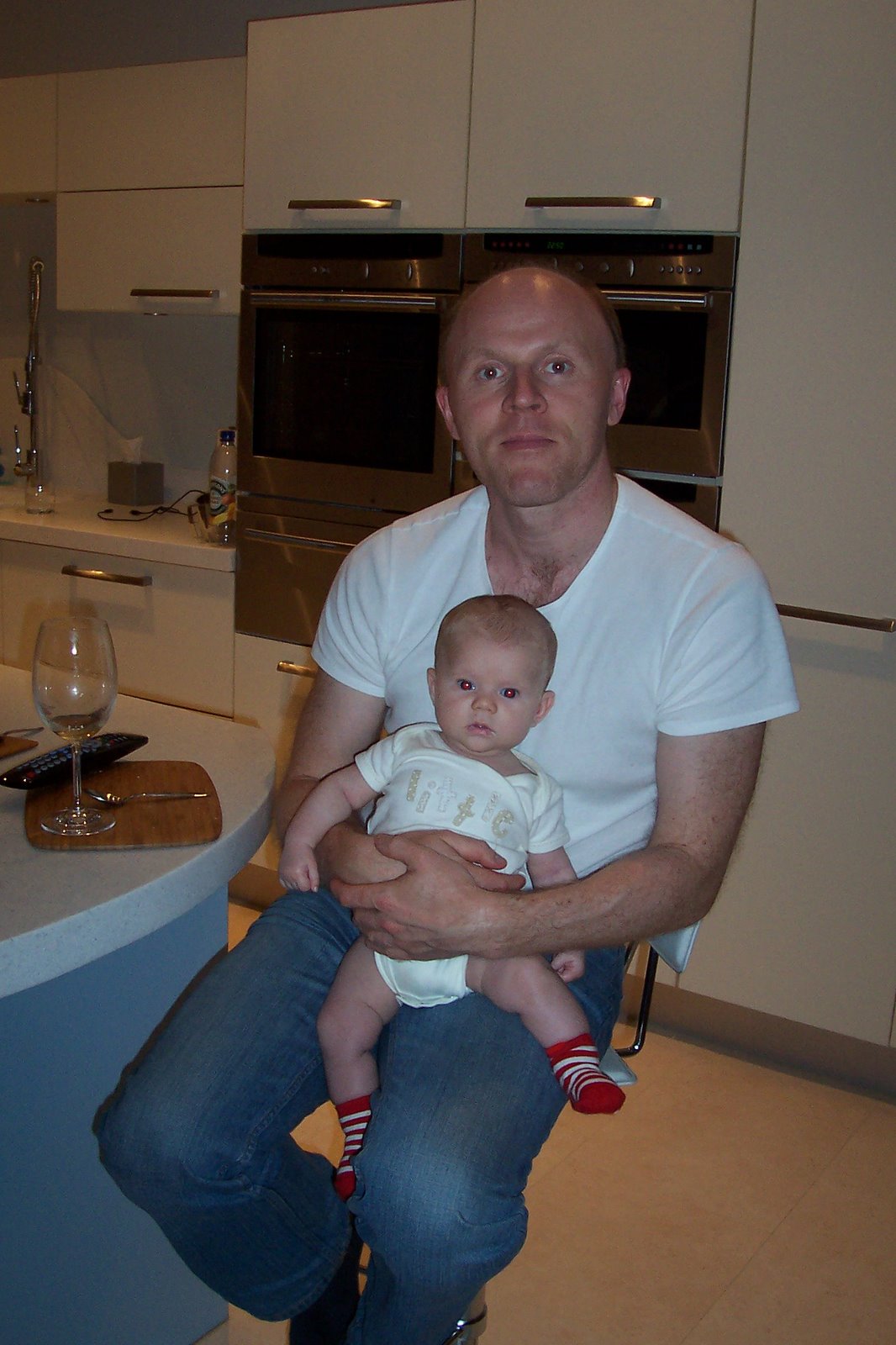
Then of course there was all the business of moving - which is a trauma all of its own - and finally the small matter of the birth of my first child at the end of May. Here is a picture of me with the little lad in the new kitchen.
Fear not, dear readers, the trials and tribulations of builders, movers and parenthood have not diverted me from making some progress with a few book projects I currently have in the pipeline.
For one of these, as mentioned a few times on previous blogs, I have been delving a little bit into a variety of the world's great but relatively unknown (in the West at least) literature. I've been ploughing on with Arabic literature (which is where I think you left me back in January) and got considerably side-tracked by the whole Orientalist debate. Impressed by Robert Irwin's excellent Penguin Anthology of Arabic Literature, I was persuaded to read his more recent tome For Lust of Knowing: The Orientalists and Their Enemies, which I'm afraid to report is an enormous disappointment, very dull to read (despite the lives of the various Arabists discussed being intrinsically fascinating).
The book is basically a nitpicking and ultimately futile rebuttal of Edward Said's Orientalism and doesn't really make any sense unless you have read that book, so I thought I should better do so. Having gone in the course of two books by Robert Irwin from thinking he was the bee's knees to thinking he needed a good talking to, I approached Orientalism with a feeling not of antipathy but rather of complete good will. And for about 30 pages, I enjoyed it, but boy, how it goes on. The central argument of Orientalism - that the West has tended to castigate the East as a mysterious 'other', strip it of its common humanity and impose upon it racial stereotypes - is entirely correct.
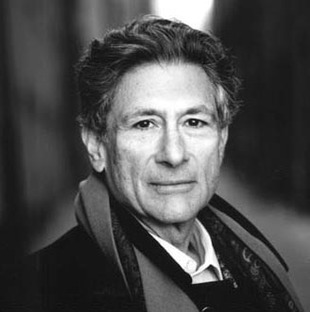
Indeed it could be considerably expanded not just from the domain of Arabic studies (which is mainly what Said writes about) but to many aspects of the West's interaction with the countries of Asia - China, Japan, India for example - and indeed many other parts of the world besides. But the whole argument requires at most 50 pages. Somehow or other, Said (pictured right) manages to string it out in one torturously boring, pompous and verbose page after another over some 300-odd pages. The most extraordinary thing is that this book has been translated into over 30 languages. How I pity the poor translators.
Anyway my belated conclusion on the whole Orientalism debate is that it's the academic equivalent of the Iran-Iraq war. What on earth are these guys all fighting about? All I can say is this: Robert Irwin would have been a lot better off devoting his energies to producing a readable guide to modern Arabic literature - something which is desperately needed.
For myself, I've been happily munching my way through the novels of Naguib Mahfouz, plus the recent bestseller The Yacoubian Building. I also got rather distracted by reading various things on central Asia such as Justin Marozzi's entertaining book on Tamerlane and am currently reading William Dalrymple's The Last Mughal.
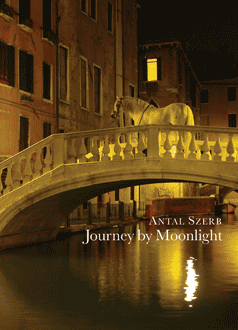
But it's a bit of a literary war on various fronts. I've been dipping my toes into Hungarian literature by reading Len Rix's excellent translation of Antal Szerb's Journey by Moonlight (Len Rix is incidentally an erstwhile English teacher of mine) and my breakfast reading is the monumental and magnificent A Man Without Qualities by Robert Musil.
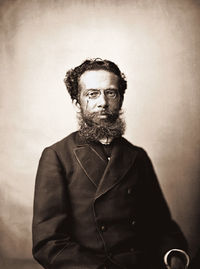
And switching continent yet again, I've also very much enjoyed getting to grips with a bit of Brazilian literature in the form of the classic Dom Casmurro by Joaquim Maria Machado de Assis (pictured left). In fact this book was the inaugural read of a book group I recently formed here in England and with whom I am hoping to tackle a variety of world classics.
There's quite a few things I've been meaning to catch up with on the blogging front however - in English and Japanese. So to make up for months of indolence, I'm hereby committing myself to a fortnightly blog in one language or another. Let's see how far I get...
Sunday, 20 January 2008
Of Bolsheviks and Orientalists
And a belated happy new year to you all, dear blogsters...
I've been kept slightly off the blogging scene for a while due to a variety of international peregrinations. After a couple of weeks in Japan, I was in North Africa over the New Year and upon my return to the UK fell victim to the dreaded Man Flu from which I have only just recovered.
First things first however. For those of you interested in matters Sosekian, quite a few reviews and articles about the new book have now appeared in the Japanese press and I will be posting links to these on the 'articles' page of the Japanese side of this site. There were articles in all five national daily newspapers as well as numerous regional newspapers and I've also been interested to read comments about the book on many blog sites and to receive personal emails from readers. (One kind reader went so far as to invite me out for dinner at a Japanese bistro with two of his friends when I was last in Osaka which made for a magical evening.)
While working hard to promote the new book on Soseki, I've been leading a slightly schizophrenic existence as I'm currently doing research on Arabic literature - of which more in a moment.
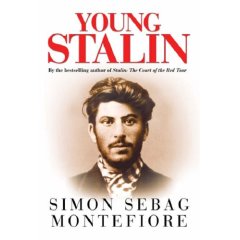
For Christmas, my girlfriend very kindly gave me a wrapped-up copy of a library book with a gift tag marked 'This is a loaner!' on it. The book was Simon Sebag Montefiore's Young Stalin and although she also gave me a variety of other (thankfully non-loaner) gifts, this was by far her best pick. I commenced reading it on Boxing Day morning and found it entirely gripping and unputdownable.
Stalin must be one of the ten most important people of the last century and yet I knew virtually nothing about what kind of person he was or how he emerged to take hold of the Soviet Empire with such an iron grip. Stalin's early career as an ex-trainee priest turned communist ideologue, gangster and relentless womanizer, who was repeatedly imprisoned and exiled, is such a fascinating story that it seems incredible that it is only now - well over fifty years after Stalin's death - that it is finally coming to light.
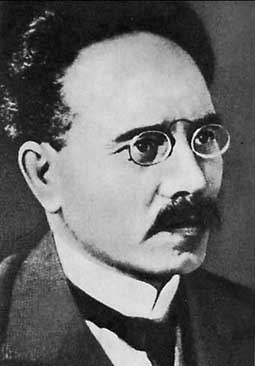
When I was a teenager I had a considerable interest in Marxism, the Bolsheviks and the radical socialists of the early twentieth century and in my youthful folly even fancied myself a great revolutionary in the making. And yet there seemed to be an iron curtain of cold unknowable remoteness about Lenin and Stalin. The victors in the Russian Revolution had done their best to cover up their human foibles and promote an aura of godlike authority. I was drawn instead towards the bungling, all-too-human history of German socialism and when I was about fifteen I was completely fascinated by such characters as Karl Kautsky, Karl Liebknecht (pictured above right) and Rosa Luxemburg.
Of the many revelations in Montefiore's book, here are just a couple. Firstly it is startling to discover that one of the chief sources of funding for the Bolsheviks in the early twentieth century were oil magnates like the Rothschilds and Nobels. Why would such embodiments of the capitalist establishment fund an organization that was so completely counter to its interests - that would indeed ultimately seize all their assets in Russia? Part of the answer was a desire to pay a kind of protection game with the Bolsheviks to prevent acts of terrorism against them; another was a sneaking sympathy with some of the Bolshevik aims and indignation with Russia's ruling class.
Then there is the question of how it was that such a dangerous character like Stalin, the mastermind behind so much murder, extortion and robbery, who was constantly monitored by the Okhrana (the Tsarist secret police) and sent to prison and Siberian exile on countless occasions, could yet live to oversee the annihilation of the entire Tsarist order. It seems extraordinary that the system of Siberian exile should have been treated as a kind of amiable reading retreat from which radicals could easily escape. The entire system of exile is described by Montefiore as a 'sieve'.
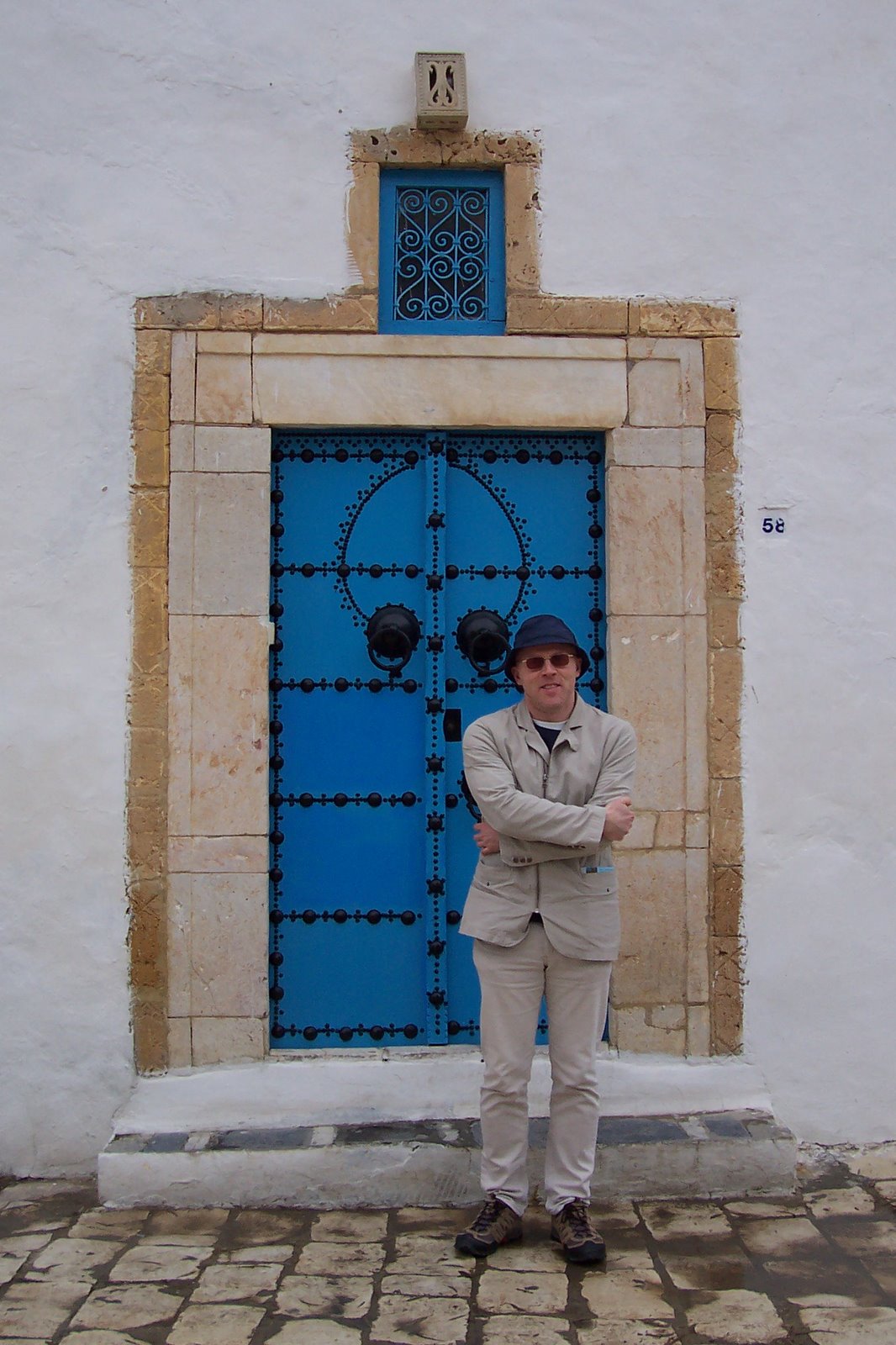
So entertained was I by this account of Stalin's early life that I decided to sacrifice some of my precious restricted baggage weight towards this hefty hardback when I set off to Tunisia. My girlfriend and I did the usual tourist thing and stayed at a hotel brimming with British holidaymakers in Sousse and then took in all the classic sights (Tunis, the Roman amphitheatre at El Djem, the caves at Matmata etc). Here is a picture of me looking suitably frozen outside a pretty doorway in Sidi Bou Said.
I had always imagined Tunisia to be a kind of tamer version of Morocco with a heavy exposure to some of the more unfortunate aspects of the tourist scene - and so it proved. A lot of people of a certain age who used to encamp themselves in British seaside hotels for the winter now seem to be ensconced in the super-cheap hotels of Tunisia. Seeing the busloads of tourists on the two-day production-line 'Sahara Explorer' trips, dressing up in local garb and doing one hour trips on camels, made me think less of Lawrence of Arabia and more of donkeys on the beach at Blackpool.
Anyway there are still many pleasures to be had. The Roman mosaics at the Bardo Museum in Tunis were a highlight. Pictured below is a marble carved section of the palace that houses the collection.

Midway through my Tunisian travels I finished Young Stalin and swapped to the more appropriate Meadows of Gold by Masudi and The Penguin Anthology of Classical Arabic Literature by Robert Irwin, a very entertaining and informative book. Thanks to the latter, I have learnt a great deal about some fascinating Arabic writers and some extraordinary lives and deaths. I certainly never knew for example that so many Arabic poems were about the pleasures of drinking alcohol or that there is such a strong tradition of satire and comedy in Arabic letters.
I particularly enjoyed the story of the poet Jahiz who so loved to read that he would pay bookshops to allow him to spend the night perusing their volumes and eventually died when a pile of books landed on him; or the quips by the poets that the only reason some people went on pilgrimage to Mecca was to check out the faces of the beautiful women not required to wear a veil en route.
The author of this book, Robert Irwin, sounds like an interesting character. The blurb tells us that as well as having taught Arabic and Middle Eastern history at various universities, he has published various books on Arabic history and art, as well as six novels of which the last was called Satan Wants Me. We are also told that he is the director of a publishing company. I note however that this anthology was first published under the title Nights and Horses and the Desert. If this was his choice of title, then I can only conclude that he is a much better writer than he is publishing director...
An internet search reveals that Irwin has also recently written a rebuttal of Edward Said's Orientalism called For Lust of Knowing. Although 'orientalism' seems to refer to the Western perception of the Islamic world, this does connect to the way in which the cultures of central and east Asia are also perceived in the West.
For example I studied Japanese at university within the confines of an absurdly named 'Oriental Studies Faculty' with Japanese, Chinese and Korean packed in alongside classes for Egyptology, Sanskrit, Aramaic and Hindi. In fact my director of studies was an expert in Sanskrit who paced around the faculty in sandals and wore an all-seeing-eye medallion on his hairy chest. What exactly had learning about modern Japanese society got to do with Sanskrit, Hebrew and Egyptian hieroglyphics apart from the fact that they were all perceived as 'oriental' in the eyes of the west?
I've never read Edward Said's book, but if it is this type of thing he is criticizing then it's hard not to agree that such attitudes towards non-western cultures are appallingly arrogant and demeaning.
On the other hand however - and here again I'm guessing the thrust of Irwin's rebuttal before actually reading it which is always dangerous - the great 'orientalists' were surely not puppets of any imperialist establishment, but rather counter culture figures who genuinely wished to explore little known cultures and explain their riches to the west. It was their love of obscure, ignored and unknown cultures that formed a common bond between them and eventually led to interests in completely different cultures being lumped together under the catch-all title 'oriental studies'.
Apparently after Said's book came out, 'orientalism' became something of a dirty word in the world of Arabic and Islamic studies. Yet, from another point of you, being an 'orientalist' - someone who is permanently trying to escape the narrow confines of western culture and explore new worlds - is surely a very fine thing to be. Indeed I'm beginning to realise that delving into Arabic literature is perhaps for me not so much a quantum leap as an extension of my own 'orientalist' interests.
I like to think of us Orientalists as the Bolsheviks of the Artistic world: few in number, lurking on the margins, permanently plotting the overthrow of the cultural establishment. Brothers and sisters, let us unite! Come the worldwide literary revolution and it'll be us, the orientalists, who will be running the planet!
Subscribe to:
Posts (Atom)